Greenfell
The Ballad of the Last DragonGreenfell is a transitional performance stop in the expedition’s campaign to spread Aeron Fowler’s heroic reputation. It is the second-to-last town visited before the company abandons the beaten path, and its importance lies less in permanent geography than in the way it concentrates the expedition’s public storytelling, audience management, and transformation of memory into spectacle.
Setting and Position in the Journey
Greenfell appears at a threshold in the expedition’s route. The company is still moving through inhabited territory and performing for crowds, but its visit is nearly over: after Greenfell, the travelers intend to venture away from the beaten path. The town therefore marks the narrowing space between public celebration and the more uncertain portion of the quest that lies ahead.
This position also gives Greenfell a practical narrative function. It is one of the final places where the expedition can recruit attention through performance before access to ordinary audiences becomes less certain. The stop belongs to the outward-facing phase of the journey, when Aeron Fowler’s story is being circulated town by town rather than preserved only among the companions who knew him.
The Performance at the Golden Selkie
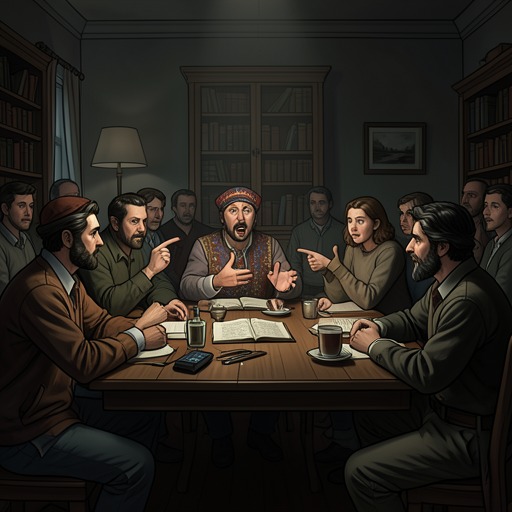
At the Golden Selkie, Sylvaine Abelan addresses the crowd with an exuberant presentation of Aeron Fowler as the greatest hero of the age. Her speech emphasizes his divine ancestry, unmatched virility, and limitless generosity, presenting a heightened public image designed to win immediate enthusiasm. The performance is not a neutral recollection of Aeron; it is an active campaign to make his legend persuasive to strangers.
Greenfell also reveals how carefully that campaign is adjusted to local reception. Sylvaine Abelan has learned that references to the goddess or her guardians alienate audiences, so she calibrates the speech by removing or reducing those elements and foregrounding qualities more likely to attract the town’s listeners. The performance thus turns storytelling into a tactical skill: the legend remains recognizably Aeron’s, but its presentation changes according to the people being addressed.
Jaromir as Living Memorial
The Greenfell performance gives Jaromir a visible role in the construction of Aeron Fowler’s posthumous image. He appears in Aeron’s armor, although only the chest plate can be worn successfully. The greaves are too short, and Jaromir’s unsuccessful attempt to walk in them becomes a source of laughter for everyone except Jaromir himself. The mismatch exposes the awkward materiality beneath the heroic performance: a dead companion’s equipment cannot simply convert another man into the same hero.
Yet the chest plate does work as a potent theatrical object. Jaromir is already associated with a hardened leather cuirass, thick arms, dark hair, and a perpetual scowl, qualities that make him appear wild and dangerous even before the disguise. At Greenfell, his hair is swept back, his beard is trimmed and tightened, and the chest plate gleams conspicuously. The result is not a perfect replacement for Aeron, but a carefully composed image that allows the absent hero to remain present onstage through another companion’s body.
Narrative Significance
Greenfell embodies the expedition’s tension between truth and useful fiction. The town receives a version of Aeron Fowler shaped for maximum effect, while Jaromir’s body supplies a visible emblem of the man who is no longer there. The too-short greaves puncture the illusion with comedy, whereas the gleaming chest plate restores its emotional force. Together, these details show that the heroic legend depends on both artifice and vulnerability.
As the second-to-last stop before the journey leaves the established road, Greenfell is also a point of transition in the expedition’s public ritual. The companions are still repeating and refining Aeron’s story for communal consumption, but the approaching departure suggests that the performance campaign is nearing its limit. Greenfell consequently stands between two modes of remembrance: the loud, adaptable spectacle offered to a crowd at the Golden Selkie and the more dangerous continuation of the quest beyond the reach of ordinary stages.